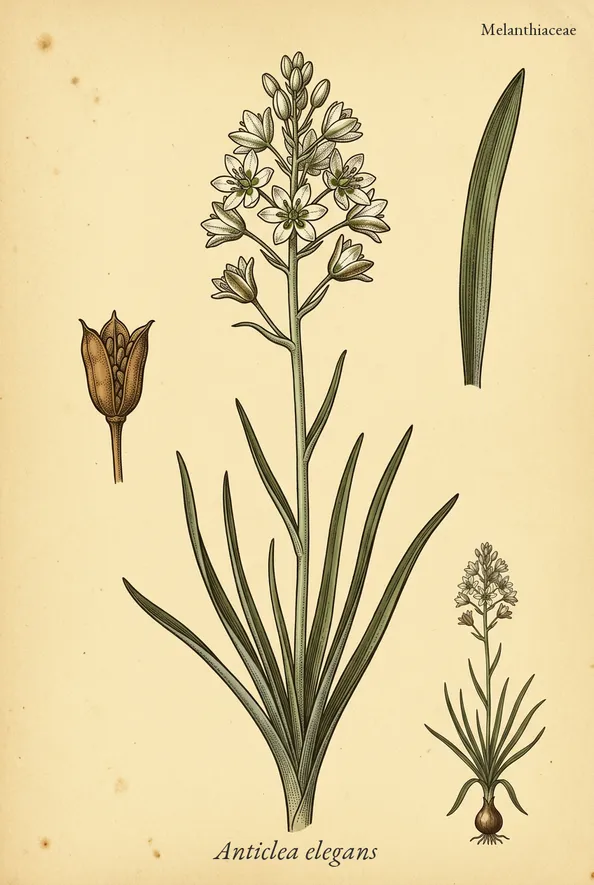
Mountain Death-camas
Anticlea elegans
- Plant Type
- Forb (Deciduous)
- Landscape Layer
- Herbaceous
- Height
- 0.8 m / 2.6 ft
- Sun
- ☀️ Full Sun, ⛅ Part Sun, ☁️ Shade
- Moisture
- 💧 Regular, 💧💧 High
- Soil
- Loam, Sand, Organic / Peat, Calcareous
- Bloom
- May, June, July, August
Pollinator Value
- ❄️ Winter Food Source
- White-tailed Ptarmigan (Phasianidae) feeds on this species, comprising 33% occurrence and 15% by weight/volume in diet studies. Note: this grouse is a western alpine/subarctic species not present in the Ottawa-Gatineau region.
Ecology & Conservation
- Proximity Score
- 0
- Native Status
- ✅ Outaouais ❌ Ottawa ✅ QC ✅ ON
- Closest Direction
- Local
- CEC Eco-Regions
- 5 – Northern Forests, 5.2 – Mixed Wood Shield, 5.2.3 – Algonquin/Southern Laurentians
- Rarity Notes
- Ranked S3 (Vulnerable) in Quebec and S4 (Apparently Secure) in Ontario. Not listed under SARA or COSEWIC. Quebec populations are concentrated along the St. Lawrence estuary and Gaspe; the species is absent from the Ottawa-Hull region floras. In Ontario, strongest populations occur in Bruce Peninsula and Manitoulin Island calcareous habitats. Nationally ranked N5 in Canada.
- Rarity Ranks
- QC S3 – Vulnerable, ON S4 – Apparently Secure
- Migration
- Stable
- Ecological Context
- Calciphilous perennial of open, wet-mesic habitats on alkaline substrates. In Ontario, found on Great Lakes dunes, rocky calcareous shores, fens, wet meadows, and alvar pavements. Quebec populations occur on calcareous shorelines along the St. Lawrence estuary and Gulf. Typically associated with Carex stricta, Dasiphora fruticosa, and Parnassia glauca in prairie fen communities.
Permaculture & Companion Planting
Edibility & Foraging ℹ
Never ingest a plant unless you have 100% certainty of its identity and have consulted multiple reputable sources. The information provided in the Localeaf Plant Database is compiled from secondary sources for educational and historical purposes only.
Click here for more info →
ℹ
Never ingest a plant unless you have 100% certainty of its identity and have consulted multiple reputable sources. The information provided in the Localeaf Plant Database is compiled from secondary sources for educational and historical purposes only.
Click here for more info →❌ Not Edible
- Foraging Notes
- All parts are highly poisonous and must never be eaten. Contains steroidal alkaloids (zygadenine) said to be more potent than strychnine. Ingestion of as few as two bulbs can be fatal, causing salivation, vomiting, diarrhea, lowered body temperature, slow heartbeat, coma, and death.
- Toxicity
-
☠️ High Toxicity
CAUTION: Despite the pre-computed toxic=None based on Cornell/USDA databases, multiple authoritative sources confirm this species is highly toxic. All parts contain steroidal alkaloids (zygadenine); ingestion of two bulbs can be fatal. Symptoms include salivation, nausea, vomiting, diarrhea, lowered body temperature, slow heartbeat, coma, and death. Poisonous to humans, cattle, and especially sheep. The bulb was historically confused with edible camas bulbs (Camassia), leading to fatalities among early settlers.
Seed Source
- Botanically Inclined