Small Camas
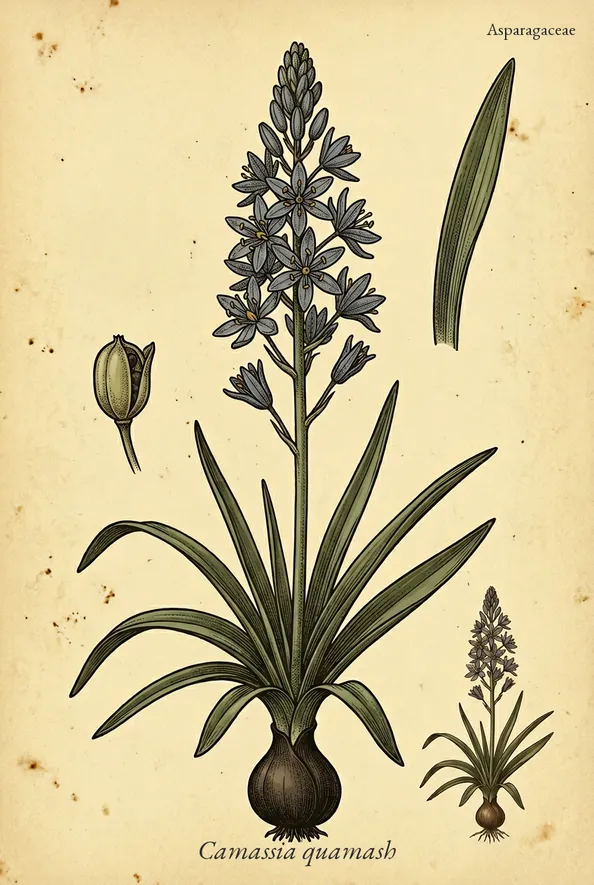
Camassia quamash
- Plant Type
- Forb (Deciduous)
- Landscape Layer
- Groundcover
- Height
- 0.7 m / 2.3 ft
- Sun
- ☀️ Full Sun, ⛅ Part Sun
- Moisture
- 💧 Regular, 💧💧 High, 💧💧💧 Wet
- Soil
- Clay, Loam, Sand, Silt
- Bloom
- April, May
- Sociability
- S2 – Small groups
Ecology & Conservation
- Proximity Score
- 4
- Native Status
- ❌ Outaouais ❌ Ottawa ❌ QC ❌ ON
- Closest Direction
- NW
- CEC Eco-Regions
- 5 – Northern Forests, 5.4 – Boreal Plains, 5.4.2 – Clear Hills and Western Alberta Uplands
- Rarity Notes
- Not native to Ontario or Quebec. NatureServe global rank G5 (Secure), Canadian national rank N5. Subnational native range limited to AB and BC in Canada. Not listed under SARA.
- Migration
- Disjunct
- Ecological Context
- A western North American bulbous geophyte of wet meadows, prairies, and open woodlands from British Columbia south to California and east to Montana and Utah. Typically found in seasonally moist sites that dry by late spring, often in heavy soils at low to mid elevations. Historically so abundant in Pacific Northwest meadows as to color entire landscapes blue-violet during bloom. Far disjunct from the Ottawa Valley with no natural occurrence east of the Rocky Mountains.
Permaculture & Companion Planting
- Roles
- Fire Retardant, Pollinator Attractor
S73/S29/S72 Evidence: Fire Retardant: S73 [MEDIUM]: S11 Fire Tolerance = Medium (not definitional)] | Pollinator Attractor: S73 [HIGH]: S64 Xerces listed (source-classified)]
- Notes
- Functions as a root-layer edible in food forest design [S72 Table 10-1]. PFAF describes naturalizing in damp orchard grass, with foliage dying back by early July to avoid interfering with fruit harvest. As a spring-blooming bulb, it provides early-season pollinator resources before most other guild plants flower.
Medicinal Properties ℹ
Always consult a qualified healthcare provider before using any plant for medicinal purposes. The information provided is compiled from secondary sources for educational purposes only.
Click here for more info →
ℹ
Always consult a qualified healthcare provider before using any plant for medicinal purposes. The information provided is compiled from secondary sources for educational purposes only.
Click here for more info →- Category
- Gynecological Aid, Oxytocic
S28 Blackfoot Drug=Gynecological Aid; S29 Birthing aid, Oxytocic
- Notes
- Blackfoot traditional medicine: decoction of roots taken to induce labor; infusion of leaves used for vaginal bleeding after birth and to help expel the placenta. Limited medicinal use overall (2 records in Moerman), with applications confined to birthing assistance.
Edibility & Foraging ℹ
Never ingest a plant unless you have 100% certainty of its identity and have consulted multiple reputable sources. The information provided in the Localeaf Plant Database is compiled from secondary sources for educational and historical purposes only.
Click here for more info →
ℹ
Never ingest a plant unless you have 100% certainty of its identity and have consulted multiple reputable sources. The information provided in the Localeaf Plant Database is compiled from secondary sources for educational and historical purposes only.
Click here for more info →✅ Edible ✅ Commonly Eaten
- Foraging Notes
- Bulbs were a staple food of western North American Indigenous peoples, pit-roasted over two days to convert inulin to sweet fructose. Cooked bulbs develop a delicious sweet flavour somewhat like sweet chestnuts. Can be dried and ground into flour for bread and cakes, or boiled down to make molasses. Moerman documents 42 food uses across numerous tribes including Blackfoot, Flathead, Nez Perce, and many coastal peoples. CAUTION: must not be confused with death camas (Zigadenus spp.) which shares similar habitat.
- Toxicity
-
☠️ High Toxicity
No known toxicity. USDA rates toxicity as None. Not listed in Cornell poisonous plants database. PFAF reports no known hazards. However, the plant must not be confused with death camas (Zigadenus spp.), a highly toxic genus that shares similar habitat and vegetative appearance.
Seed Source
- Cicada Seeds