
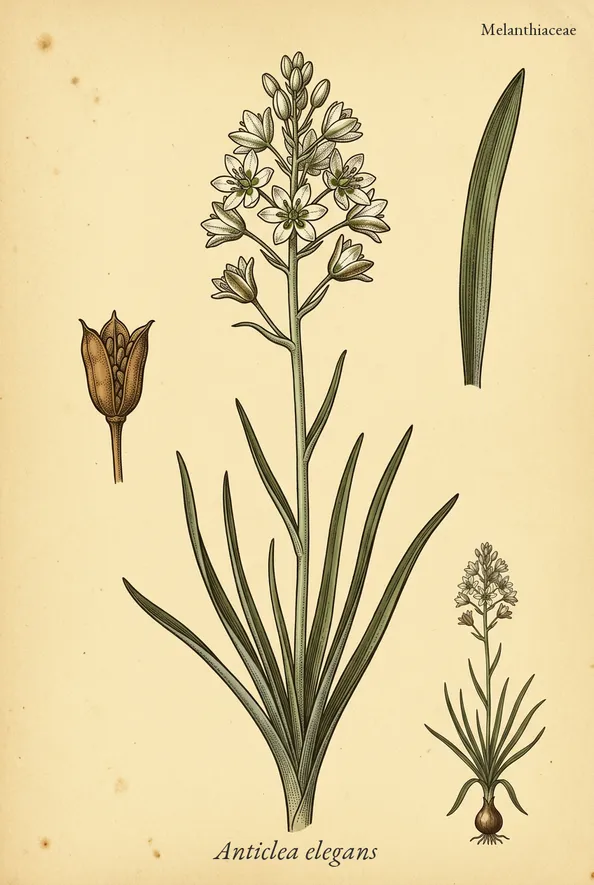
Mountain Deathcamas
Anticlea elegans
- Plant Type
- Forb (Deciduous)
- Landscape Layer
- Herbaceous
- Height
- 0.8 m / 2.6 ft
- Sun
- ☀️ Full Sun, ⛅ Part Sun, ☁️ Shade
- Moisture
- 🏜️ Dry, 💧 Regular, 💧💧 High, 💧💧💧 Wet
- Soil
- Loam, Sand, Organic / Peat, Calcareous
- Bloom
- May, June, July, August
- Sociability
- S1 – Solitary / small clusters
Ecology & Conservation
- Proximity Score
- 0
- Native Status
- ✅ Outaouais ❌ Ottawa ✅ QC ✅ ON
- Closest Direction
- Local
- CEC Eco-Regions
- 5 – Northern Forests, 5.2 – Mixed Wood Shield, 5.2.3 – Algonquin/Southern Laurentians
- Rarity Notes
- Ranked S3 (Vulnerable) in Quebec and S4 (Apparently Secure) in Ontario. Not listed under SARA or COSEWIC. In Quebec, occurrences are scattered along the St. Lawrence and in Gaspesie; the species is more widespread in Ontario, especially on the Bruce Peninsula and Manitoulin Island. National rank N5 (Secure) in Canada.
- Rarity Ranks
- QC S3 – Vulnerable, ON S4 – Apparently Secure
- Migration
- Stable
- Ecological Context
- A bulb geophyte of calcareous mountain meadows, rocky slopes, and open forests. In Ontario, specimens concentrate on the Bruce Peninsula and Manitoulin Island on limestone substrates; Quebec occurrences are primarily in the St. Lawrence lowlands and Gaspesie. Grows in wet meadows, fens, alvars, and cedar swamps, often on calcareous soils.
Medicinal Properties ℹ
Always consult a qualified healthcare provider before using any plant for medicinal purposes. The information provided is compiled from secondary sources for educational purposes only.
Click here for more info →
ℹ
Always consult a qualified healthcare provider before using any plant for medicinal purposes. The information provided is compiled from secondary sources for educational purposes only.
Click here for more info →- Category
- Analgesic, Antirheumatic, Dermatological Aid, Diaphoretic, Strengthener, Veterinary Aid
- Notes
- Multiple Indigenous uses documented by Moerman. Thompson people used pulverized baked root as a salve for pain in the back and feet. Western Keres used an infusion of eleven plants (including this species) as an athletic rubdown and in sweatbaths before deer hunts. Navajo Ramah used a cold infusion as a lotion for coyote bites. All medicinal uses are external; the plant is recognized as highly poisonous by all groups who employed it.
Edibility & Foraging ℹ
Never ingest a plant unless you have 100% certainty of its identity and have consulted multiple reputable sources. The information provided in the Localeaf Plant Database is compiled from secondary sources for educational and historical purposes only.
Click here for more info →
ℹ
Never ingest a plant unless you have 100% certainty of its identity and have consulted multiple reputable sources. The information provided in the Localeaf Plant Database is compiled from secondary sources for educational and historical purposes only.
Click here for more info →❌ Not Edible
Seed Source
- Akène