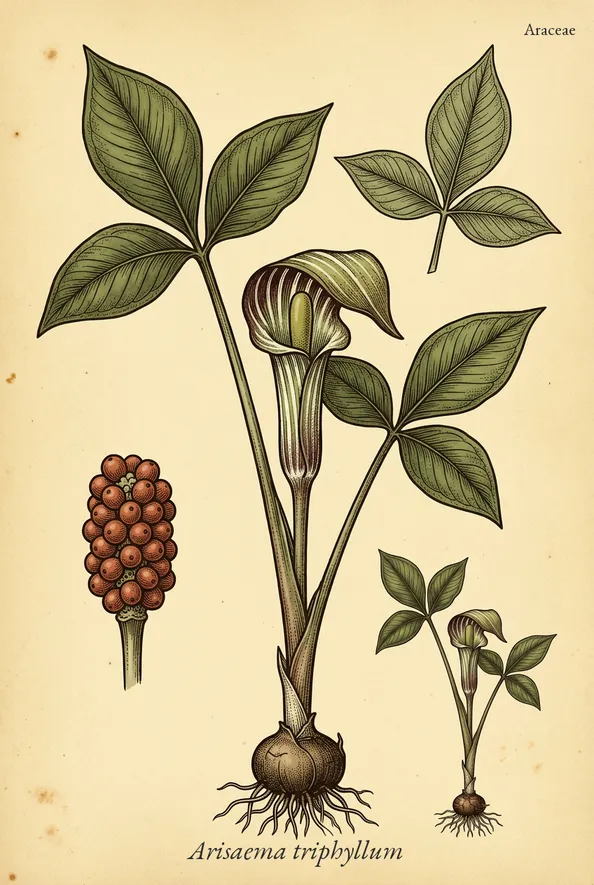
Jack-in-the-pulpit
Arisaema triphyllum
- Plant Type
- Forb (Deciduous)
- Landscape Layer
- Herb
- Height
- 0.5 m / 1.5 ft
- Spring Ephemeral
- Yes
- Sun
- ⛅ Part Sun, ☁️ Shade
- Moisture
- 💧 Regular
- Soil
- Loam, Sand, Silt, Organic / Peat, Calcareous
- Bloom
- June, July
- Sociability
- S2 – Small groups
Pollinator Value
- 🐛 Larval Host
- Spilosoma latipennis
- ❄️ Winter Food Source
- Bright red berry clusters ripen in late summer and persist into fall, providing food for woodland birds including Wild Turkey (Meleagris gallopavo) and Wood Thrush (Hylocichla mustelina). Fruits are animal-dispersed berries.
S57 Wild Turkey diet_type=Occurrence, fraction=7.3%; S10 Wood Thrush + Wild Turkey eat berries; S44 dispersal=Animal/Birds
Ecology & Conservation
- Proximity Score
- 0
- Native Status
- ✅ Outaouais ✅ Ottawa ✅ QC ✅ ON
- Closest Direction
- Local
- CEC Eco-Regions
- 5 – Northern Forests, 5.2 – Mixed Wood Shield, 5.2.3 – Algonquin/Southern Laurentians
- Rarity Notes
- Globally secure (G5) and nationally secure in both Canada (N5) and the United States (N5). Ranked S5 (Secure) in Ontario but SNR (Not Ranked) in Quebec. Not listed under SARA or COSEWIC. Common throughout its range in the Ottawa-Gatineau region.
S22 G5, N5, S5-ON, SNR-QC; S26 not SARA listed; S63 Common in Ottawa-Hull
- Rarity Ranks
- QC SNR – Not Ranked, ON S5 – Secure
- Migration
- Stable
- Ecological Context
- A characteristic understory perennial of rich, mesic deciduous forests. Typically found in beech-maple and northern hardwood forests on moist, humus-rich soils, often in ravines, floodplains, and springy spots. Associates with Trillium grandiflorum, Dentaria laciniata, Dicentra cucullaria, and Claytonia virginica in the spring ephemeral layer. Also occurs in cedar swamps, mixed swamp forests, and along wetland margins.
S7 beech-maple forests, ravines, swamps; S10 mesic deciduous woodlands; S61 mesic forests, swamps, riparian forests, peatlands; S4 Forest, Woodland, Swamp, Marsh
Permaculture & Companion Planting
Medicinal Properties ℹ
Always consult a qualified healthcare provider before using any plant for medicinal purposes. The information provided is compiled from secondary sources for educational purposes only.
Click here for more info →
ℹ
Always consult a qualified healthcare provider before using any plant for medicinal purposes. The information provided is compiled from secondary sources for educational purposes only.
Click here for more info →- Category
- Analgesic, Antirheumatic, Antiseptic, Carminative, Cold Remedy, Contraceptive, Dermatological Aid, Diaphoretic, Expectorant, Eye Medicine, Stimulant
S28 Cherokee + Iroquois + Chippewa uses; S29 PFAF medicinal categories
- Notes
- Extensively used by Indigenous peoples of eastern North America. Cherokee used root poultices for headaches, skin diseases, boils, and ringworm, and internally for colds, dry coughs, and as an expectorant. Iroquois used compound decoctions for pain, bronchial colds, sore eyes, and as a contraceptive. Chippewa used root decoction as a wash for sore eyes. The dried root is antiseptic, diaphoretic, and stimulant; the fresh root is considered too dangerously acrid for internal use.
S28 63 Moerman uses across Cherokee, Iroquois, Chippewa; S29 medicinal properties
Edibility & Foraging ℹ
Never ingest a plant unless you have 100% certainty of its identity and have consulted multiple reputable sources. The information provided in the Localeaf Plant Database is compiled from secondary sources for educational and historical purposes only.
Click here for more info →
ℹ
Never ingest a plant unless you have 100% certainty of its identity and have consulted multiple reputable sources. The information provided in the Localeaf Plant Database is compiled from secondary sources for educational and historical purposes only.
Click here for more info →❌ Not Edible
- Foraging Notes
- The corm is technically edible only after extremely thorough preparation to neutralize calcium oxalate crystals. Roots must be sliced very thin and dried for several months, or pounded into powder and left to dry for weeks. Used historically by Indigenous peoples as an emergency food, but raw or improperly prepared corm causes intense burning pain in the mouth and throat. PFAF rates edibility 3/5 but with strong caution.
S29 edibility rating 3/5, preparation details; S31 calcium-oxalate in plant; S4 calcium oxalate crystals cause painful irritation
- Toxicity
-
△ Low Toxicity
All parts contain needle-like calcium oxalate crystals (raphides) that cause intense burning pain and irritation of the mouth, tongue, and gastrointestinal tract if ingested raw. The corm and foliage are the most concentrated. Crystals are neutralized by thorough drying or cooking. Contact with fresh corm sap can cause skin blisters. Mammalian herbivores rarely consume this plant due to the extreme acridity.
S29 calcium oxalate crystals, burning sensation; S31 CALCIUM-OXALATE in plant; S4 calcium oxalate crystals cause painful irritation, roots can cause blisters; S3 toxic to humans and pets if ingested
Seed Source
- Localeaf
- OWSL