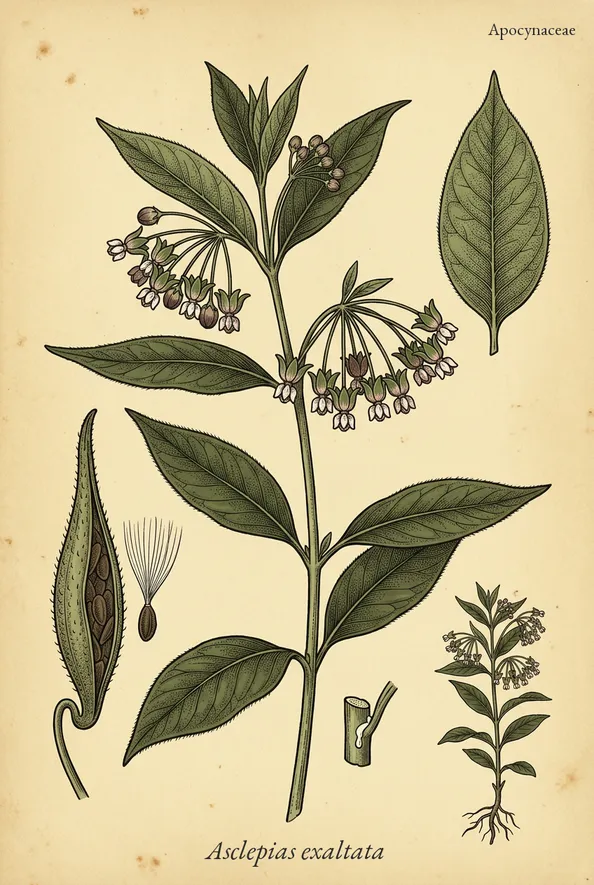
Poke Milkweed
Asclepias exaltata
- Plant Type
- Herbaceous perennial (Deciduous)
- Landscape Layer
- Herbaceous Layer
- Height
- 1.5 m / 5 ft
- Sun
- ⛅ Part Sun, ☁️ Shade
- Moisture
- 🏜️ Dry
- Soil
- Loam, Sand, Rocky / Acidic, Calcareous
- Bloom
- May, June, July, August
- Sociability
- S2 – Small groups
Pollinator Value
- 🐛 Larval Host
- Danaus plexippus, Pyrrharctia isabella, Hyalophora cecropia, Euchaetes egle, Cycnia tenera, Phragmatobia lineata, Trichordestra legitima, Spodoptera frugiperda, Melanchra adjuncta, Papaipema nebris
- ❄️ Winter Food Source
- Follicles split open in fall to release wind-dispersed seeds with silky comas. Persistent dried stems and split pods may provide minor winter foraging substrate for seed-gleaning birds, though primary value is as a summer nectar source.
Ecology & Conservation
- Proximity Score
- 2
- Native Status
- ✅ Outaouais ❌ Ottawa ✅ QC ✅ ON
- Closest Direction
- SE
- CEC Eco-Regions
- 8 – Eastern Temperate Forests, 8.1 – Mixed Wood Plains, 8.1.7 – Northeastern Coastal Zone
- Rarity Notes
- Critically imperiled in Quebec (S1) at the northern margin of its range. Globally secure (G5). Not listed under SARA or COSEWIC. Rare at margins of range; considered of conservation concern in several peripheral jurisdictions. In Quebec, known from very few locations.
- Rarity Ranks
- QC S1 – Critically Imperiled, ON S4 – Apparently Secure
- Migration
- Stable
- Ecological Context
- A deciduous forest understory milkweed typically found in rich mesic to dry-mesic woodlands dominated by oaks, maples, and hickories. Prefers dappled shade on slopes, ravines, and woodland edges. In Michigan, associated with Acer saccharum, Tilia americana, and Allium tricoccum in mesic hardwood forests. Reaches its northern limit in southern Quebec where it is critically imperiled (S1).
Permaculture & Companion Planting
Medicinal Properties ℹ
Always consult a qualified healthcare provider before using any plant for medicinal purposes. The information provided is compiled from secondary sources for educational purposes only.
Click here for more info →
ℹ
Always consult a qualified healthcare provider before using any plant for medicinal purposes. The information provided is compiled from secondary sources for educational purposes only.
Click here for more info →- Category
- Gastrointestinal Aid
S28 Moerman Drug category=Gastrointestinal Aid (Omaha, Ponca)
- Notes
- Omaha and Ponca peoples ate the raw root as a treatment for stomach trouble (Gilmore 1919). Recorded in Moerman's NAEB with 2 drug/gastrointestinal aid entries. No other traditional medicinal uses documented for this species.
Edibility & Foraging ℹ
Never ingest a plant unless you have 100% certainty of its identity and have consulted multiple reputable sources. The information provided in the Localeaf Plant Database is compiled from secondary sources for educational and historical purposes only.
Click here for more info →
ℹ
Never ingest a plant unless you have 100% certainty of its identity and have consulted multiple reputable sources. The information provided in the Localeaf Plant Database is compiled from secondary sources for educational and historical purposes only.
Click here for more info →❌ Not Edible
Seed Source
- Prairie Moon