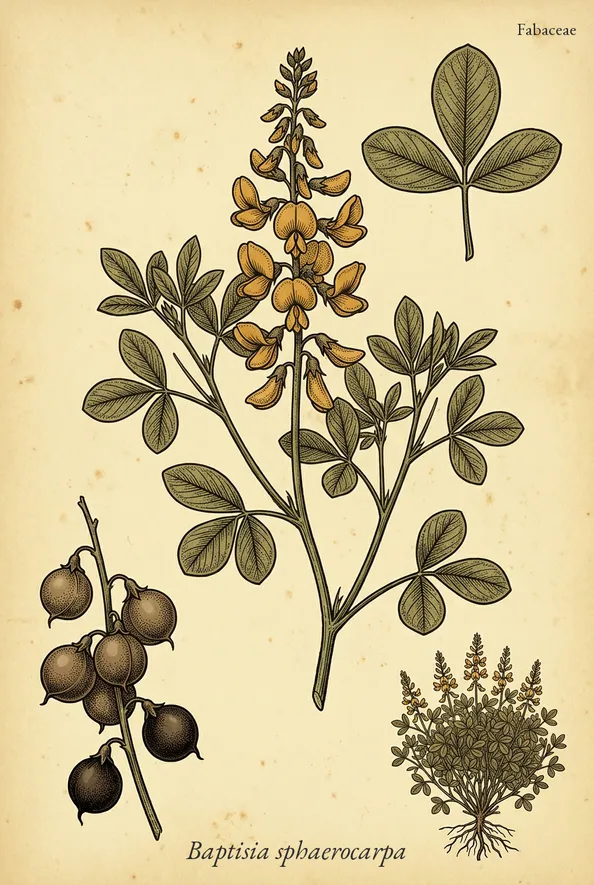
Yellow Wild Indigo
Baptisia sphaerocarpa
- Plant Type
- Herbaceous perennial (Deciduous)
- Landscape Layer
- Herb
- Height
- 1.2 m / 3.9 ft
- Sun
- ☀️ Full Sun
- Moisture
- 🏜️ Dry, 💧 Regular
- Bloom
- May, June, July
Pollinator Value
Ecology & Conservation
- Proximity Score
- 3a
- Native Status
- ❌ Outaouais ❌ Ottawa ❌ QC ❌ ON
- Closest Direction
- SW
- CEC Eco-Regions
- 8 – Eastern Temperate Forests, 8.5 – Mississippi Alluvial and Southeast USA Coastal Plains, 8.5.2 – Mississippi Alluvial Plain
- Rarity Notes
- Globally secure (G4). Native range restricted to south-central US (AR, LA, MO, MS, OK, TX). Not ranked in Ontario or Quebec as the species does not occur in either province. Not SARA listed.
- Migration
- Disjunct
- Ecological Context
- Southern Great Plains and Gulf Coast prairie species native to AR, LA, MO, MS, OK, and TX. Grows in open prairies, roadsides, and woodland edges on well-drained to dry soils in full sun. Slow to establish but exceptionally long-lived once rooted. Significantly disjunct from the Ottawa-Gatineau region.
S4 distribution AR/LA/MO/MS/OK/TX; S46 full sun, dry soil; S22 G4
Permaculture & Companion Planting
- Roles
- Pollinator Attractor
S73/S29/S72 Evidence: Pollinator Attractor: S73 [HIGH]: S64 Xerces listed (source-classified)]
- Notes
- As a leguminous species (Fabaceae), Baptisia sphaerocarpa fixes atmospheric nitrogen through root-nodule symbiosis, enriching surrounding soil. Its deep root system and clump-forming habit make it a stable structural element in prairie plantings.
Edibility & Foraging ℹ
Never ingest a plant unless you have 100% certainty of its identity and have consulted multiple reputable sources. The information provided in the Localeaf Plant Database is compiled from secondary sources for educational and historical purposes only.
Click here for more info →
ℹ
Never ingest a plant unless you have 100% certainty of its identity and have consulted multiple reputable sources. The information provided in the Localeaf Plant Database is compiled from secondary sources for educational and historical purposes only.
Click here for more info →❌ Not Edible
Seed Source
- Northern Wildflowers