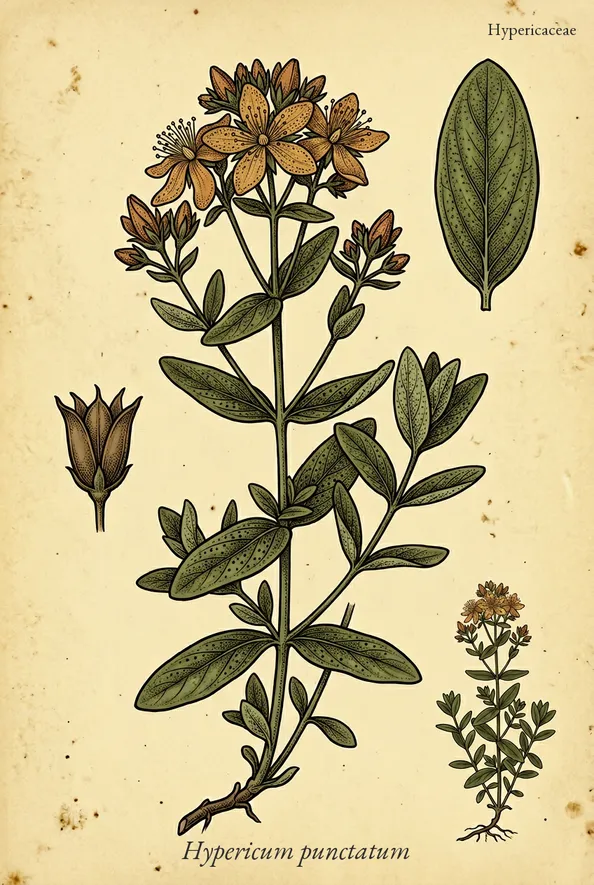
Spotted St. John’s-wort
Hypericum punctatum
- Plant Type
- Forb (Deciduous)
- Landscape Layer
- Herbaceous
- Height
- 0.9 m / 3 ft
- Sun
- ☀️ Full Sun, ⛅ Part Sun
- Moisture
- 💧 Regular
- Soil
- Clay, Loam, Sand, Silt, Rocky / Acidic
- Bloom
- June, July
- Sociability
- S2 – Small groups
Pollinator Value
- 🐛 Larval Host
- Synchlora aerata, Nedra ramosula, Cryptocala acadiensis, Phlogophora iris, Hyppa xylinoides, Nemoria bistriaria, Zale lunata, Eupithecia subfuscata, Melanchra assimilis
- ❄️ Winter Food Source
- Seeds of Hypericum are consumed by Ring-necked Duck (Aythya collaris), comprising approximately 2% of diet by weight or volume. Seeds are small (0.046-0.06 g per 1000 seeds) but produced in moderate abundance.
S57 Ring-necked Duck 1.95% diet; S44 seed weight 0.046-0.06g/1000
Ecology & Conservation
- Proximity Score
- 0
- Native Status
- ✅ Outaouais ✅ Ottawa ✅ QC ✅ ON
- Closest Direction
- Local
- CEC Eco-Regions
- 5 – Northern Forests, 5.2 – Mixed Wood Shield, 5.2.3 – Algonquin/Southern Laurentians
- Rarity Notes
- Ranked S3 (Vulnerable) in Quebec but S5 (Secure) in Ontario and G5 globally. Not listed under SARA or COSEWIC. The species is uncommon in the Ottawa region according to the Brunton Ottawa Flora 2005. Quebec herbarium specimens (20 in CNH/MT) span from 1987 to 2018 across southern Quebec.
S22 ranks; S26 SARA not listed; S62 Uncommon Ottawa; S54 20 QC specimens
- Rarity Ranks
- QC S3 – Vulnerable, ON S5 – Secure
- Migration
- Stable
- Ecological Context
- Spotted St. John's-wort occupies marshy or swampy ground, stream banks, forest borders, and dry to moist fields. In the Ottawa-Gatineau region it is uncommon, ranked S3 (Vulnerable) in Quebec. Michigan Flora records it in mesic forests with Quercus bicolor and Acer saccharinum, floodplain woods, and open disturbed fields.
Permaculture & Companion Planting
Medicinal Properties ℹ
Always consult a qualified healthcare provider before using any plant for medicinal purposes. The information provided is compiled from secondary sources for educational purposes only.
Click here for more info →
ℹ
Always consult a qualified healthcare provider before using any plant for medicinal purposes. The information provided is compiled from secondary sources for educational purposes only.
Click here for more info →- Category
- Drug
S28 Meskwaki Drug (Unspecified)
- Notes
- The Meskwaki (Fox) people used a compound containing the root as a medicine, the specific application unspecified. Related species H. perforatum is widely known medicinally, but ethnobotanical records for H. punctatum are limited to this single Meskwaki use documented by Huron H. Smith (1928).
S28 Meskwaki Drug, compound containing root
Edibility & Foraging ℹ
Never ingest a plant unless you have 100% certainty of its identity and have consulted multiple reputable sources. The information provided in the Localeaf Plant Database is compiled from secondary sources for educational and historical purposes only.
Click here for more info →
ℹ
Never ingest a plant unless you have 100% certainty of its identity and have consulted multiple reputable sources. The information provided in the Localeaf Plant Database is compiled from secondary sources for educational and historical purposes only.
Click here for more info →❌ Not Edible
Seed Source
- OWSL