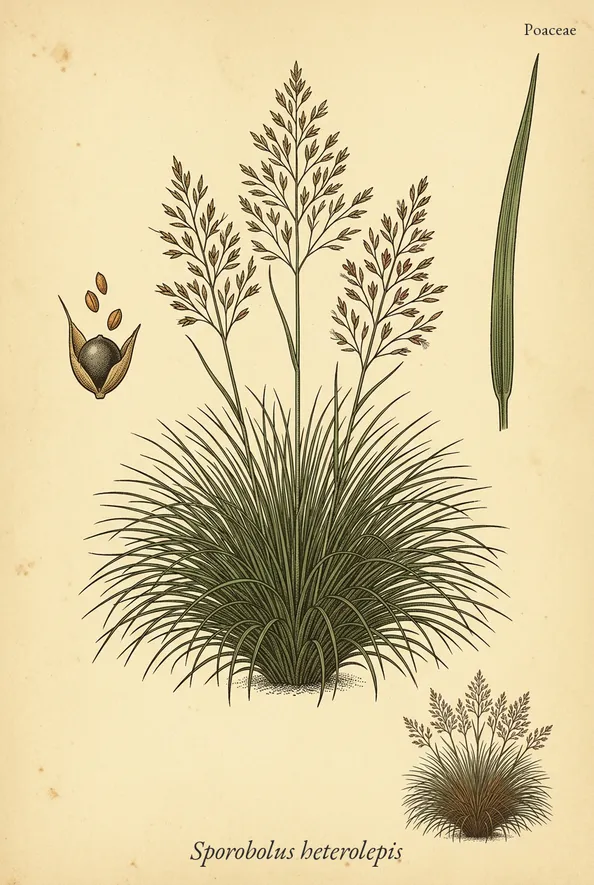
Prairie Dropseed
Sporobolus heterolepis
- Plant Type
- Grass (Deciduous)
- Landscape Layer
- Groundcover
- Height
- 0.7 m / 2.3 ft
- Sun
- ☀️ Full Sun, ⛅ Part Sun
- Moisture
- 🏜️ Dry, 💧 Regular
- Soil
- Loam, Silt, Calcareous
- Bloom
- June, July, August
- Sociability
- S2 – Small groups
Pollinator Value
- 🐛 Larval Host
- Hesperia leonardus
- ❄️ Winter Food Source
- Seeds are eaten by sparrows and other granivorous songbirds from late summer into winter, including Field Sparrow, Savannah Sparrow, Tree Sparrow, and Slate-Colored Junco. LeConte's Sparrow feeds on seeds (2.2% of diet by weight).
S10 seed-eating songbirds listed; S57 LeConte's Sparrow diet record
Ecology & Conservation
- Proximity Score
- 0
- Native Status
- ✅ Outaouais ✅ Ottawa ✅ QC ✅ ON
- Closest Direction
- Local
- CEC Eco-Regions
- 5 – Northern Forests, 5.2 – Mixed Wood Shield, 5.2.3 – Algonquin/Southern Laurentians
- Rarity Notes
- Ranked S3 (Vulnerable) in both Ontario and Quebec, and nationally N4. Not SARA listed. In Quebec, concentrated along the Ottawa River in Pontiac County on calcareous alvars. In Ontario, known from alvar sites in the Ottawa area including Burnt Lands Provincial Park. The species is globally secure (G5) but at the northeastern edge of its range in the Ottawa Valley.
S22 S3 ON, S3 QC, G5, N4; S26 not SARA listed; S62 Ottawa sites; S54 QC specimens from Pontiac
- Rarity Ranks
- QC S3 – Vulnerable, ON S3 – Vulnerable
- Migration
- Stable
- Ecological Context
- In the Ottawa-Gatineau region, prairie dropseed occupies calcareous alvars and limestone shorelines along the Ottawa River, particularly around lac-des-Chats near Bristol Mines in Pontiac County. QC specimens are found on riverine alvars on Beekmantown dolomite and sandy xeric openings. On the Ontario side, it occurs at Burnt Lands (locally abundant on alvar), Shirleys Bay (Innis Point), and Morris Island. A provincially rare species (S3 in both ON and QC) characteristic of remnant prairie and alvar habitats on calcareous substrates.
S48 specimen localities on alvars; S62 Ottawa sites; S54 QC herbarium records from lac-des-Chats alvars; S22 S3 rank both provinces
Permaculture & Companion Planting
Medicinal Properties ℹ
Always consult a qualified healthcare provider before using any plant for medicinal purposes. The information provided is compiled from secondary sources for educational purposes only.
Click here for more info →
ℹ
Always consult a qualified healthcare provider before using any plant for medicinal purposes. The information provided is compiled from secondary sources for educational purposes only.
Click here for more info →- Category
- Dermatological Aid, Emetic, Liver Aid
S28 Moerman categories: Drug (Dermatological Aid, Emetic, Liver Aid)
- Notes
- Southern Ojibwa used root preparations medicinally: a poultice of crushed root was applied to sores (dermatological aid), and a decoction of root was taken as an emetic to remove bile (also considered a liver aid). Documented by Hoffman 1891 from the Midewiwin.
S28 Moerman NAEB Ojibwa uses; S61 confirms Ojibwa root poultice
Edibility & Foraging ℹ
Never ingest a plant unless you have 100% certainty of its identity and have consulted multiple reputable sources. The information provided in the Localeaf Plant Database is compiled from secondary sources for educational and historical purposes only.
Click here for more info →
ℹ
Never ingest a plant unless you have 100% certainty of its identity and have consulted multiple reputable sources. The information provided in the Localeaf Plant Database is compiled from secondary sources for educational and historical purposes only.
Click here for more info →❌ Not Edible
Seed Source
- Akène
- NANPS
- Akene