
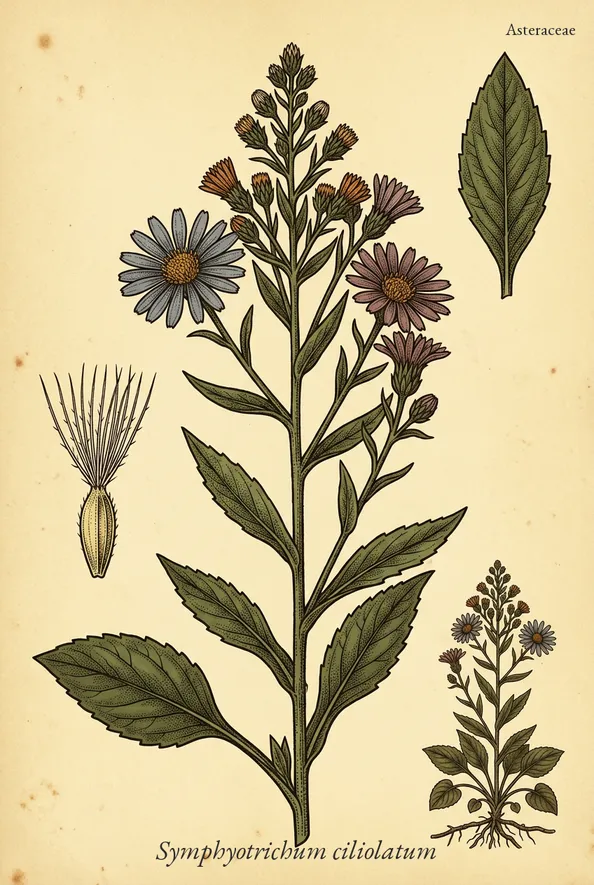
Lindley’s Aster
Symphyotrichum ciliolatum
- Plant Type
- Herb (Deciduous)
- Landscape Layer
- Herbaceous
- Height
- 0.9 m / 3 ft
- Sun
- ☀️ Full Sun, ⛅ Part Sun
- Moisture
- 🏜️ Dry, 💧 Regular
- Soil
- Clay, Loam, Sand, Rocky / Acidic, Calcareous
- Bloom
- July, August, September, October
- Sociability
- S3 – Small colonies
Pollinator Value
- 🐝 Specialist Bee Host
- Andrena asteris, Andrena canadensis, Andrena hirticincta, Andrena nubecula, Andrena placata, Andrena simplex, Colletes americanus, Colletes compactus, Colletes simulans, Pseudopanurgus aestivalis, Pseudopanurgus andrenoides
S17 genus-level Symphyotrichum specialists with Eastern NA ranges
Ecology & Conservation
- Proximity Score
- 0
- Native Status
- ✅ Outaouais ❌ Ottawa ✅ QC ✅ ON
- Closest Direction
- Local
- CEC Eco-Regions
- 5 – Northern Forests, 5.2 – Mixed Wood Shield, 5.2.3 – Algonquin/Southern Laurentians
- Rarity Notes
- Globally secure (G5) and secure in both Ontario and Quebec (S5/S5). Not listed under SARA or COSEWIC. Widespread across boreal and mixed-wood forests of Canada from Yukon to the Maritimes.
- Rarity Ranks
- QC S5 – Secure, ON S5 – Secure
- Migration
- Stable
- Ecological Context
- Lindley's aster occupies rich, open boreal deciduous forests (aspen, aspen-birch-fir-spruce), forest edges, clearings, and thickets, often in calcareous substrates. In the Ottawa Valley it is found in sandy to loamy soils along woodland borders, trails, and roadsides. It is a characteristic species of northern Mixed Wood Shield communities, frequently associated with Populus tremuloides, Solidago spp., and Corylus cornuta.
Permaculture & Companion Planting
Medicinal Properties ℹ
Always consult a qualified healthcare provider before using any plant for medicinal purposes. The information provided is compiled from secondary sources for educational purposes only.
Click here for more info →
ℹ
Always consult a qualified healthcare provider before using any plant for medicinal purposes. The information provided is compiled from secondary sources for educational purposes only.
Click here for more info →- Category
- Ophthalmology, Stimulant
S4 eye drops from boiled roots; smoke from burning roots to revive unconscious persons
- Notes
- Native peoples boiled the strongly scented roots to make eye drops and used smoke from burning roots to revive people who had fainted in sweat baths (Kershaw). No records in Moerman NAEB database under this binomial, likely recorded under former name Aster ciliolatus.
Edibility & Foraging ℹ
Never ingest a plant unless you have 100% certainty of its identity and have consulted multiple reputable sources. The information provided in the Localeaf Plant Database is compiled from secondary sources for educational and historical purposes only.
Click here for more info →
ℹ
Never ingest a plant unless you have 100% certainty of its identity and have consulted multiple reputable sources. The information provided in the Localeaf Plant Database is compiled from secondary sources for educational and historical purposes only.
Click here for more info →❌ Not Edible
Seed Source
- OWSL