
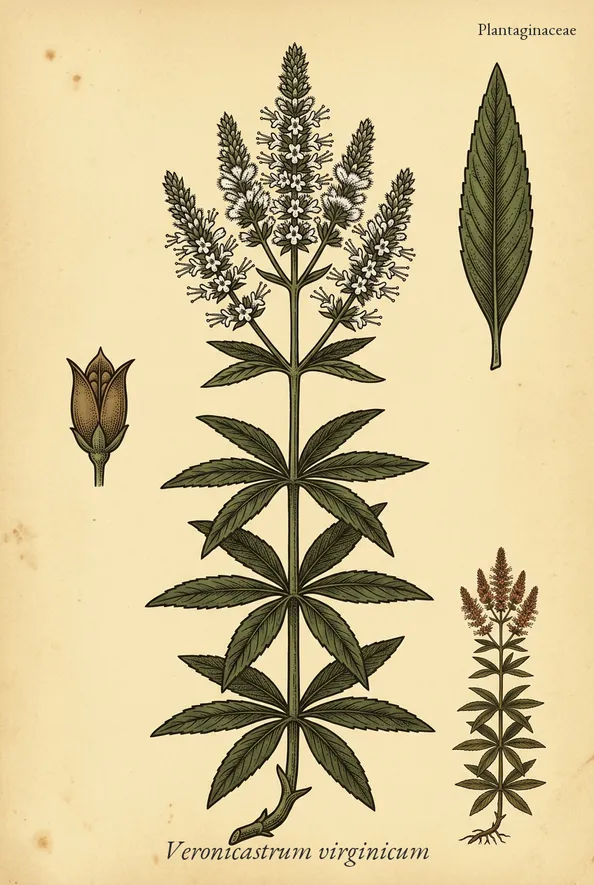
Culver’s Root
Veronicastrum virginicum
- Plant Type
- Forb (Deciduous)
- Landscape Layer
- Herbaceous
- Height
- 1.5 m / 5 ft
- Sun
- ☀️ Full Sun, ⛅ Part Sun
- Moisture
- 💧 Regular
- Soil
- Clay, Loam, Sand, Silt, Rocky / Acidic, Organic / Peat, Calcareous
- Bloom
- June, July, August, September
Pollinator Value
Ecology & Conservation
- Proximity Score
- 2
- Native Status
- ❌ Outaouais ❌ Ottawa ❌ QC ✅ ON
- Closest Direction
- SE
- CEC Eco-Regions
- 8 – Eastern Temperate Forests, 8.1 – Mixed Wood Plains, 8.1.7 – Northeastern Coastal Zone
- Rarity Notes
- Globally secure (G4) but nationally rare in Canada (N2) and imperiled in Ontario (S2). Not listed under SARA. The species reaches the northeastern edge of its range in southern Ontario, where it is found primarily in remnant prairies and fens. Most Canadian populations are concentrated in southwestern Ontario.
- Rarity Ranks
- ON S2 – Imperiled
- Migration
- Stable
- Ecological Context
- A tall perennial forb of moist prairies, meadows, fens, and open deciduous woods. In Michigan, documented in prairie remnants, river banks, deciduous savannas (especially with oaks), and adjacent roadsides. Nationally rare in Canada (N2), confined to Ontario and Manitoba. The species occupies mesic to wet-mesic habitats and is characteristic of tallgrass prairie and savanna ecosystems.
Permaculture & Companion Planting
Medicinal Properties ℹ
Always consult a qualified healthcare provider before using any plant for medicinal purposes. The information provided is compiled from secondary sources for educational purposes only.
Click here for more info →
ℹ
Always consult a qualified healthcare provider before using any plant for medicinal purposes. The information provided is compiled from secondary sources for educational purposes only.
Click here for more info →- Category
- Analgesic, Cathartic, Cholagogue, Diaphoretic, Emetic, Febrifuge, Hepatic, Laxative, Tonic
- Notes
- Extensively used by Cherokee, Chippewa, Iroquois, and Menominee peoples. The root is the primary medicinal part: a powerful cathartic and emetic when fresh, milder when dried. Cherokee used infusions for backache, fever, and as a purgative. Iroquois employed root infusions for diarrhea, coughs, chills, fevers, rheumatism, and gallstones. The root also stimulates bile production (cholagogue). Health Canada lists it as a homeopathic substance. Some caution advised: the fresh root is a violent cathartic and the plant is considered potentially toxic.
Edibility & Foraging ℹ
Never ingest a plant unless you have 100% certainty of its identity and have consulted multiple reputable sources. The information provided in the Localeaf Plant Database is compiled from secondary sources for educational and historical purposes only.
Click here for more info →
ℹ
Never ingest a plant unless you have 100% certainty of its identity and have consulted multiple reputable sources. The information provided in the Localeaf Plant Database is compiled from secondary sources for educational and historical purposes only.
Click here for more info →❌ Not Edible
- Foraging Notes
- No edible uses are documented. PFAF assigns an edibility rating of 0/5. Moerman records 39 ethnobotanical uses, all in medicinal or ceremonial categories, with none classified as food.
- Toxicity
-
⚠️ Moderate Toxicity
Not listed in Cornell poisonous plants database. PFAF notes the plant is 'potentially toxic' and Iroquois considered it poisonous. OWSL flags it as 'toxic to mammals if ingested.' The fresh root acts as a violent cathartic and emetic, which may account for toxicity reports, but no specific toxic compounds are identified in the sources consulted. Cornell absence and USDA 'None' classification support the None rating.
Seed Source
- Localeaf
- Akène